Chief Atlantic
The TommyknockersChief Atlantic, whose proper Micmac name was Wahwayvokah, is remembered through the history of his people, his reported deathbed curse, and the forest that became his only monument. The novel gives him no extended onstage life: he enters through the recollections of the woods’ past, where Indigenous dispossession, uncertain testimony, and a long record of violence converge.
Identity and Historical Background
The name Chief Atlantic was not Wahwayvokah’s own. White people applied it as a contemptuous translation of his Micmac name, which means “by tall waters.” The distinction makes the surviving label itself part of the history being recalled: the name by which local memory recognizes him records not his chosen identity but the outsiders’ account of him.
Wahwayvokah led a people whose territory had once covered much of what became Penobscot County. Their principal communities were in Oldtown, Skowhegan, and the Great Woods, which began in Ludlow. After influenza decimated the people in the 1880s, survivors buried their dead in Ludlow and drifted south with Wahwayvokah. He presided over a further decline, so his journey into the woods was already bound to a history of catastrophe before his death there.
Death and the Reported Curse
Wahwayvokah died in 1885. On his deathbed, he declared the woods to which he had brought his dying people cursed. Two white witnesses were present: an anthropologist from Boston College and another from the Smithsonian Institution. They had come to the region seeking Indigenous artifacts from Northeastern tribes they regarded as rapidly degenerating and soon to disappear. Their presence gives the report a traceable chain of transmission, but it does not resolve what the curse meant or whether it originated with Wahwayvokah.
The narrative explicitly leaves that question open. He may have been placing the curse himself, or merely describing a condition he believed already existed. That uncertainty is central to his remembered significance: the account preserves his warning without claiming to know its source, allowing the forest’s later history to echo it without turning the report into proof.
The Woods as Monument and Local Memory
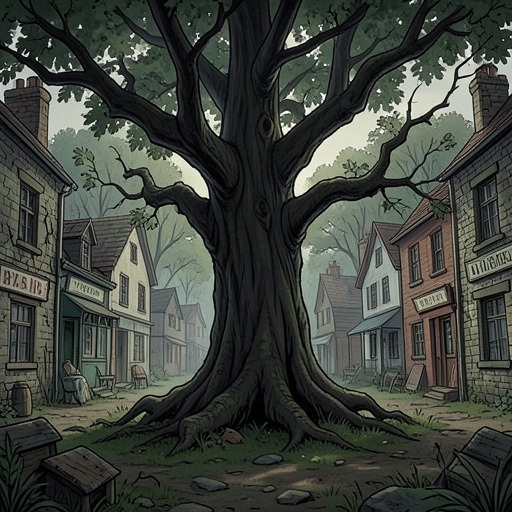
Big Injun Woods was, as far as Ev knew, Wahwayvokah’s only monument; even the location of his grave had been lost. The forest name endured in common local use in Haven and the other towns within the area, although the cartographers preparing the Maine atlas might have avoided printing it because people had become sensitive to casual slurs. The place-name thus kept his story present while also carrying the contemptuous language imposed on him.
The woods’ reputation appeared to corroborate the old warning. Ev recalled that they had not been lucky for Wahwayvokah, nor for the Clarendons, and that hunters had repeatedly suffered there. In his mental record of Haven hunting accidents, he could summon about a dozen cases, most involving shootings: hunters were carried out bleeding, unconscious, or dead. Some had shot themselves after using loaded guns as crutches over fallen trees or dropping them; one death was reputed to be suicide. Ev also remembered two November murders, one following a card-game argument at a camp and the other a dispute between friends over whose bullet had killed a record-breaking buck.
Narrative Significance
Wahwayvokah’s story reaches the reader as inherited local knowledge rather than a direct account. Ev listens to what he calls the town’s memory, and his father’s saying that old tales often contain a grain of truth shapes his response: Ev agrees, while admitting through his recollections that the woods’ curse cannot simply be separated from its many ordinary, human tragedies. This framing makes the past consequential without resolving it into a single explanation.
The contrast between a vanished grave and a lasting, derogatory place-name gives Wahwayvokah’s legacy its particular force. His people’s displacement and decline survive in fragments—an anthropologist’s report, a translated name, a remembered curse, and stories of deaths in the woods—rather than in an intact community or secure monument. The forest can therefore be read at once as a site of Indigenous loss and as a landscape onto which later residents project a history of danger. Wahwayvokah’s warning remains inseparable from that layered memory, even when its meaning cannot be settled.